description: ( ? )
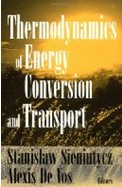
Scientists and engineers are nowadays faced with the problem of optimizing complex systems subject to constraints from, ecology, economics, and thermodynamics. It is chiefly to the last of these that this volume is addressed. Intended for physicists, chemists, and engineers, the book uses examples from solar, thermal, mechanical, chemical, and environmental engineering to focus on the use of thermodynamic criteria for optimizing energy conversion and transmission. The early chapters centre on solar energy conversion, the second section discusses the transfer and conversion of chemical energy, while the concluding chapters deal with geometric methods in thermodynamics.
Table of Contents
List of contributors
Preface
Part I: Theory
I.1. Progress in Variational Formulations for Macroscopic Processes
S. Sieniutycz (Warsaw, Poland), H. Farkas (Budapest, Hungary)
I.2. Lagrange-Formalism and Thermodynamics of Irreversible Processes:
The 2nd Law of Thermodynamics and the Principle of Least Entropy Production as
Straightforward Structures in Lagrange-Formalism
K.-H. Anthony (Paderborn, Germany)
I.3. Fundamental Problems of Variational Principles: Objectivity,
Symmetries and Construction
T. Matolcsi, P. Va’n and J. Verha’s (Budapest, Hungary)
I.4. Semi-Inverse Method for Establishment of Variational Principles for
Incremental Thermoelasticity with Voids
Ji-H. He (Shanghai, People’s Republic of China)
I.5. Variational Formulations of Relativistic Elasticity and Thermo-
Elasticity
J. Kijowski (Warsaw, Poland) and G. Magli (Milano, Italy)
I.6. The Geometric Variational Framework for Entropy in General
Relativity
L. Fatibene, M. Francaviglia and M. Raiteri (Torino, Italy)
I.7. Translational and Rotational Motion of a Unaxial Liquid Crystal as
Derived Using Hamilton’s Principle of Least Action
B. J. Edwards (Knoxville, USA)。。。。。。。。
 Welcome to our reading store! Remy reads books with you!