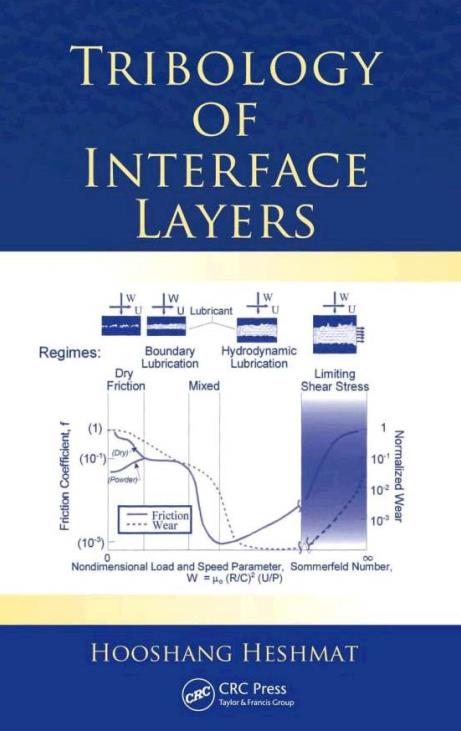
Tribology of Interface Layers by Hooshang Heshmat (May 25, 2010)
Preface
Two sets of experimental evidence, one old and the other rather recent, were the impetus to write Tribology of Interface Layers. The old evidence, which has long
plagued lubrication engineers and analysts, is the fact observed both in the laboratory and in industrial applications that many tribological devices, such as flat
surface and centrally pivoted sliders, can act as viable bearings in contradiction to basic hydrodynamic theory. The recent evidence in the same direction is the
documented observation that minute particles or powder films, whether introduced deliberately or generated spontaneously as a result of normal wear, exhibit quasihydrodynamic features that enable them to act much as conventional fluid film
bearings do. This led, in the first instance, to a redefinition of a lubricant as any intermediate layer that does not constitute or remain an integral part of the two
mating surfaces. This would then embrace anything from molecular layers to coatings, gases, and liquids, as well as powders and other solid particles small enough
to form a tribological film.
The present volume on interface layers in tribology then has two objectives. One is to demonstrate the presence of a continuum across the spectrum of lubrication regimes ranging from dry friction to full fluid film lubrication, which offers
a most striking example of the above continuum; next, bearings, seals, dampers, and similar devices using submicron powder lubricants are shown to possess quasi-hydrodynamic characteristics akin to conventional fluid films. Thus,
powder-lubricated tribological devices make excellent candidates for operation in extreme environments.
 Welcome to our reading store! Remy reads books with you!